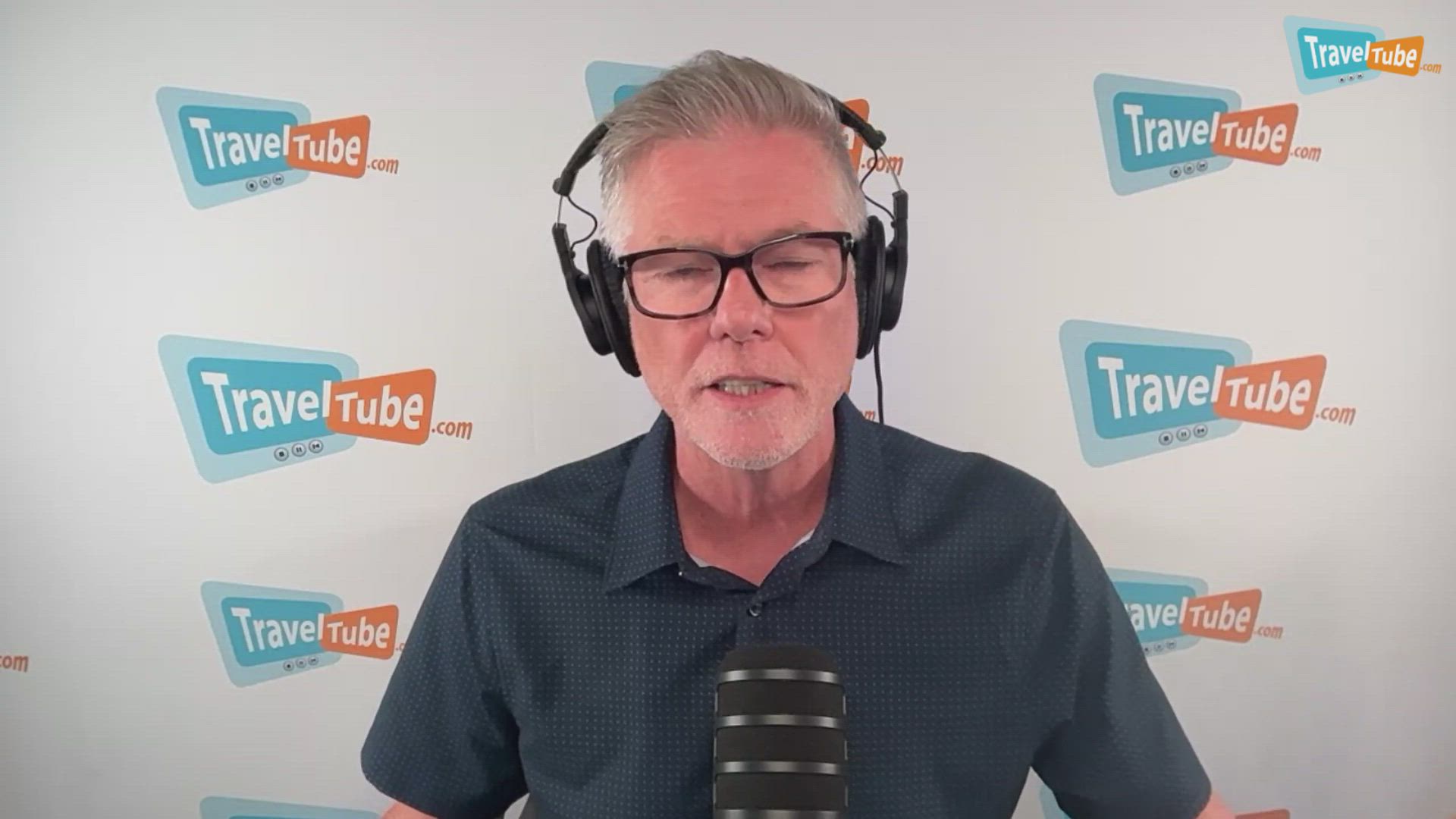
TravelTube Podcast
Host: Mark Murphy | TravelTube.com
Hi, I'm Mark Murphy with TravelTube.com. Thanks for joining me this week.
If you're a travel advisor or agent, you're part of the Travel Expert channel — this channel, TravelTube.com. That's why I do this: to position you as the actual experts. So get off your ass, sign up at the website for the e-newsletter. We don't spam you. We don't sell your names or any of that stuff. That's something you can do to help yourself so we can continue to succeed and spread the word about the professionalism of travel agents. Do me a favor and follow me on your favorite podcast apps as well as your favorite social media — we're everywhere. Actually, forget "favorite." Follow us on all of them. It helps boost our numbers and our visibility, which in turn makes you more visible.
This Week's Topics
Now that I've got the unpaid commercial out of the way, here's what I'm going to talk to you about this week:
1. Using miles when you book with a travel agent. If you're a consumer and a heavy business traveler, pay attention — we'll cover why this is a good idea.
2. Tiered pricing — what you see from airlines, hotels, and resorts. I'll explain the strategy behind it and what to watch out for. These topics apply to both consumers and agents, though hopefully most agents already understand this.
3. An "I told you so" moment: airlines using fuel prices as an excuse to raise costs — and admitting they won't lower them if fuel drops.
4. Another day, another hack — this time Booking.com. If you have bookings there, your information may be compromised. I'll talk about how to keep your personal details safe.
5. Rising travel costs and how to have an amazing vacation without breaking the bank.
6. Las Vegas overpriced itself and is finally starting to course-correct.
Using Miles with a Travel Agent
Someone sent me a message through Facebook suggesting I talk about using miles to book with a travel agent — and I thought, that's a really good idea. A lot of people don't think of that. They figure they've got the miles, so they'll just book it themselves.
Here's the reality: for most of us, we're going to accumulate a lot of miles, but we're generally not going to be able to plan and book an entire trip exclusively with miles. But you can marry your reward points or miles with a travel professional and put together an incredible trip. I'd encourage any frequent traveler who earns miles to do exactly that.
If you're a corporate traveler, you're probably already using a travel agent for business travel — and you've experienced the benefits. When something goes wrong and you need to change plans, you're not the one standing in line trying to figure out which connection to take. Your corporate travel agent handles it, often 24/7 through a call center. A good leisure agent has backup too and can do the same.
You already understand the value of a travel agent. Now apply that knowledge with your points. To me, that's just smart business and smart booking. Travel agents often have deals that aren't available in the public domain — particularly for luxury travel. If you're booking a Hampton Inn for a quick business trip, sure, you can do that yourself. But if you're booking a Ritz-Carlton, Four Seasons, or the Peninsula in Chicago, there are absolutely deals that aren't visible to the public.
For example, when I booked through my American Express agent, I could get "book two nights, get the third night free," daily breakfast, a spa credit, and more. That's the kind of value you can stack with your miles and loyalty points to stretch your dollars and experience as far as possible.
Tiered Pricing: The Strategy Behind the Low Price
I see a lot of people frustrated online about airline and hotel pricing — and rightfully so. Here's what's happening and why.
When people search online, they typically sort by lowest price. To appear at the top of results, airlines and hotels strip out everything and show you the bare minimum rate. Want seat selection? That's extra. Bringing a bag? Extra. Economy Plus? Extra. By the time you add everything back in, that $150 fare might cost $300. Their attitude is: show up low in the search results, then layer on the fees.
The same thing happens with hotel resort fees. You see $50 a night and think you've found a deal — then you get to checkout and it's suddenly $400 for three nights. Why? Resort fees. And the most absurd part is that some of those fees cover things like gym access and pool use — basic services you'd expect to be included. And yes, many city hotels that aren't resorts by any definition still charge a "resort fee." You're going to pay it regardless of whether you use anything.
A good travel agent will cut through all of that and give you the actual cost upfront — not the teaser rate. They'll tell you, "Here's your real cost per ticket for your family of four." Don't be fooled by the lead price. You're going to pay more.
Airlines Admit Prices Won't Come Down
Here's my "I told you so" moment. I said the airlines were using fuel prices as an excuse to raise costs — and now the CEOs of Delta and United have essentially confirmed it. In interviews on CNBC and during earnings calls, they've admitted they won't commit to lowering prices even if jet fuel prices come back down. They want those higher prices to stick.
And they get cover from each other. The four major airlines control about 80% of domestic air travel in the U.S. If everyone holds the line on pricing, prices stick. They won't drop until one of them blinks — and then the others will follow. As an entrepreneur, I understand the logic: if customers are willing to pay more, you charge more. But it's still frustrating.
I was on Fox News last weekend discussing this (you can watch it at TravelTube.com). Prices are currently up roughly 8–12% across the board and could go as high as 20%. On a $300 average domestic fare, that's maybe $360 — probably not a trip-killer for most people. But it's not uniform. Some routes like Denver are essentially flat; others like Miami to LAX are up only slightly. The impact varies by route, so check tools like Google Flights to see where fares are trending compared to historical data.
The bigger picture: airlines are also cutting frequency and reducing seats on certain routes to ensure planes fly full. Less supply plus steady demand equals prices that stick. Don't count on a significant fare drop any time soon.
Booking.com Hack: How to Protect Yourself
Booking.com was hacked. If you've booked through them, your personal information may now be in the hands of people trying to exploit it. Here's what happened: hackers accessed user data and are now impersonating the hotel or Booking.com to try to extract more personal or financial information from you.
The good news: your actual credit card number is typically encrypted and inaccessible — even internally. The bad news: your contact information and booking details can be used for very convincing phishing attacks.
Here's how to protect yourself:
• Always check the sender's email address before clicking anything. Phishing emails often come from random Gmail, Hotmail, or oddly formatted addresses — not the actual company domain. • Never click links or open attachments in unexpected emails asking you to update payment info. • If you're unsure, call the reservation line of the hotel, airline, or online travel agency directly to verify. • If you go to Booking.com, make sure you're on the real site — scammers create near-perfect replicas. • If a deal looks too good to be true (like a $20 jacket from a luxury brand), it's a scam.
One more thing worth noting: when you book on Expedia, Orbitz, Booking.com, or Priceline, you are booking on a travel agency's website. You're doing all the research, making the transaction, handling everything yourself — and they're collecting the commission. A traditional travel agent does all of that work for you and typically charges you nothing extra. Most agents are free to use 99% of the time. Some charge a planning fee upfront, but that fee often applies toward your booking if you go ahead within a set timeframe — a reasonable filter to weed out people who just want free advice.
Travel Costs: How to Vacation Without Breaking the Bank
Yes, travel costs are up. But there are smart ways to still have an incredible vacation. Here are a few ideas:
Travel with other couples or families. Rent a large Airbnb-style house and split the cost. I have a six-bedroom beach house at the Jersey Shore — if six couples shared it, you'd have a phenomenal week for potentially $1,000–$2,000 per couple, cooking some meals in and walking to the beach. Hard to beat that value.
Consider a dude ranch. I recently spoke with someone about this — I'm genuinely excited about it and planning to go. Depending on the time of year, it can be incredibly cost-effective. A family of four can do six nights at a dude ranch — all meals included, horseback riding, hikes, ranch experiences — for around $7,200–$8,000 in the lower-demand months (summer in Arizona). Some ranches are near national parks like Yellowstone and include guided day trips. If you can drive there, it's even cheaper. That's an exceptional value for a memorable, all-inclusive family experience.
Travel in the shoulder season. Families are locked into summer travel, but couples and solo travelers have more flexibility. Right after Thanksgiving, early January, and mid-April (after spring break) are excellent windows with lower prices and smaller crowds. Down here in Fort Lauderdale, it's dramatically cheaper than it was just a few weeks ago during spring break.
River cruising in Europe — but in fall, not summer. Skip August when many shops in France close for the month and crowds are at their worst. Instead, book an October cruise or a Christmas Markets cruise. Yes, it'll be cooler — but you're not there to sunbathe. You're visiting castles, cathedrals, and charming towns like Regensburg in Bavaria. A jacket and the same incredible food and experiences — at potentially half the price of a summer sailing.
Homeport cruising. About 70% of the U.S. population has a cruise ship accessible within a reasonable drive. Ships depart from ports up and down the East and West Coasts. You skip the airport, avoid baggage fees and TSA lines, and save significantly on airfare. Drive down to Port Everglades, Jacksonville, or Cape Canaveral — even from the Northeast it's a manageable two-day drive — and you're off.
Las Vegas Gets the Message
Las Vegas pushed too far. Hotels at $400–$500 on weekends, $65 resort fees, $100 steaks with sides and drinks billed separately, $27 cocktails — the market pushed back. Numbers don't lie, and Vegas is starting to correct course. We'll see how far they go, but the message seems to be getting through.
Final Thoughts
You can spend big, do it on a budget, or find something great in between. The key is knowing your options, timing your travel smartly, and working with a travel professional who can help you find the best value for your specific situation. Don't be afraid to tell them you want an amazing experience at the best price you can get. A good agent will make that happen.
Thanks for listening. Please follow us on all your podcast apps and social media, and sign up for our newsletter at TravelTube.com to get this content as soon as it drops. I'll catch you next time.